lunes, 30 de abril de 2007

Tierra Santa y contradictoria

Posted by Emilio López  |  at   13:03

He escrito este post a petición de un amigo, brasileño, que lo ha publicado en su blog sobre Tierra Santa. Desde aquí mi agradecimiento no sólo por este hecho, sino por sus largas horas de acompañamiento en esta peregrinación. Obrigado, Frei Fabrício.
Visiten aquí su blog.
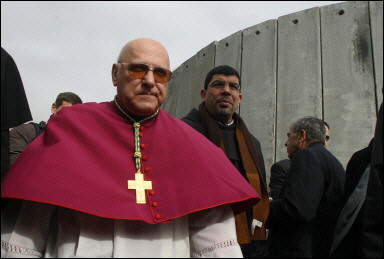
Cuando, desde nuestros países natales, occidentales (en mi caso, España) oímos la palabra “árabe”, inmediatamente viene a nuestra mente la idea de “musulmán”, y en algunos casos, “terrorismo”, o al menos, intolerancia religiosa. Con la mano en el corazón, puedo decir que este fue mi caso, antes de mi llegada a Tierra Santa hace ya casi dos meses; y por supuesto, antes de conocer a Suad, Tony, Jacqueline…, cristianos católicos, que confiesan a Jesús como Mesías en lengua árabe.
La suerte me ha hecho encontrar a estas personas, grandes de corazón y de alma, que viven su fe en medio de unas dificultades insospechadas por la gran mayoría de católicos. Aunque la minoría cristiana palestina convive sin mayores problemas con los musulmanes, a veces surgen conflictos. Pero no es lo más común. Sin embargo, sí que viven “asimilados” por el hecho de ser palestinos, con respecto a las autoridades judías. Me explico: los soldados, policías e incluso los dirigentes políticos hebreos parece que no distinguen entre cristianos y musulmanes dentro de la población palestina. Piénsese el resultado de intentar distinguir entre diferentes confesiones cristianas. El resultado: más y más problemas, por ejemplo, para poder ir a Jerusalén a celebrar la Semana Santa, algo que los “turistas” occidentales podemos hacer casi sin ninguna perturbación. O el tener que soportar controles para pasar de una ciudad a otra (dentro del territorio supuestamente bajo control de la autoridad palestina) que son, al menos, humillantes, a parte de ilegales.
Como ya he dicho, he tenido la gran fortuna de encontrarme personalmente, y crear lazos de amistad con algunos cristianos de Tierra Santa. Su acogida, su atención, su amabilidad son signo de sus raíces semíticas, además de una señal de lo profundo que llega en ellos las enseñanzas de Jesús. Quien dé un vaso de agua a alguien en mi nombre… Este post quiere ser un agradecimiento a este pueblo de puertas abiertas, de profundas convicciones y de arraigadas costumbres que me ha recibido de una manera inesperada y ha abierto mis ojos a una realidad que me era totalmente ajena y desconocida. Y al mismo tiempo, este post debe empezar a abrir los ojos de todos los que lo lean: nuestros hermanos cristianos, pocos en número pero grandes de alma, están sufriendo. No pretendo crear o aumentar un sentimiento anti-judío. Al contrario, me gustaría que nuestro apoyo como cristianos pasase por el diálogo y la colaboración para que el conflicto acabe de la mejor manera posible. Pero sí he de reconocer que la situación es más complicada de lo que se oye fuera de estas tierras. Así que, pidamos a Dios que dé luz a todos los implicados en la construcción de la sociedad, para que se pueda hacer realidad lo que dice Isaías: “de las espadas forjarán arados, de las lanzas, podaderas. Ya no se alzará pueblo contra pueblo, ni se prepararán para la guerra. Casa de Jacob, ven, caminemos en la luz del Señor.”

0 comentarios :

domingo, 29 de abril de 2007

La Palabra de Dios en la vida y misión de la Iglesia

Posted by Unknown  |  at   6:13

Colgamos los «Lineamenta» para la próxima asamblea general del Sínodo de los Obispos que se celebrará en el 2008. Recordamos que es el primer paso de los preparativos sobre el que se realizará el «instrumentum laboris» que será el documento final de trabajo en el Sínodo. Por eso, se acompaña de los cuestionarios para los distintos organismos eclesiales que enriquecerán, matizarán o corregirán la versión final antes de la Asamblea. Fuente: Zenit


(Si pinchas el último icono [arriba-derecha] te saldrá el documento en otra pestaña más grande)

0 comentarios :

miércoles, 25 de abril de 2007

"From Ratzinger to Benedict" (Cardenal A. Dulles)

Posted by Rubén García  |  at   12:08

En este extenso artículo para la revista First Things (febrero 2006) el cardenal estadounidense Avery Dulles, sj, habla de la decisiva labor de J. Ratzinger como perito conciliar y de su evolución a "teólogo crítico" ante algunos aspectos imprevistos del postconcilio. Resume con mucha claridad su evolución teológica.

Like his predecessor John Paul II, Benedict XVI was present at all four sessions of the Second Vatican Council from 1962 to 1965. Whereas Karol Wojtyla took part as a bishop, the young Joseph Ratzinger did so as a theological expert. During and after the council he taught successively at the universities of Bonn (1959-1963), Münster (1963-1966), Tübingen (1966-1969), and Regensburg, until he was appointed Archbishop of Munich in 1977. In 1981 he became prefect of the Congregation for the Doctrine of the Faith, a post he held until the death of John Paul II in April 2005.
In his many publications Ratzinger continued to debate questions that arose during the council and in some cases expressed dissatisfaction with the council’s documents

Continúa...
In this respect he differs from Pope John Paul, who consistently praised the council and never (to my knowledge) criticized it. The material conveniently divides into three stages: his participation at the council, his early commentaries on the council’s documents, and his later reflections on the reception of the council. And then there are his changing reactions to the four great constitutions: on the liturgy (Sacrosanctum Concilium), on revelation (Dei Verbum), on the Church (Lumen Gentium), and on the Church in the modern world (Gaudium et Spes).
At the council, Ratzinger was much sought after as a rising theological star. He worked closely with senior Jesuits, including Karl Rahner, Alois Grillmeier, and Otto Semmelroth, all of whom kept in steady communication with the German bishops. The German Cardinals Josef Frings of Cologne and Julius Döpfner of Munich and Freising, strongly supported by theologian-bishops such as the future Cardinal Hermann Volk, exercised a powerful influence, generally opposing the schemas drawn up by the preparatory commission under the guidance of Cardinal Alfredo Ottaviani and Father Sebastian Tromp, S.J.
Late in the first session Ratzinger was named a theological adviser to Cardinal Frings, a position he held until the end of the council. Many of his biographers suspect that he drafted Frings’ speech of November 8, 1963, vehemently attacking the procedures of the Holy Office. In combination with other events, this speech undoubtedly influenced Paul VI to restructure the Holy Office and give it a new name, the Congregation for the Doctrine of the Faith.
During the first session, several official schemas were distributed by the preparatory commission with the expectation that the council fathers would accept them, at least in revised form. The German contingent were generally content with the proposed document on the liturgy, but reacted adversely to those on revelation and the Church and sought to replace them.
With regard to revelation, Ratzinger agreed that the preliminary schema was unacceptable and should be withdrawn. At the request of Cardinal Frings, he wrote an alternative text, which was then reworked with the help of Rahner. To the annoyance of Ottaviani, three thousand copies of this text were privately circulated among the council fathers and experts. Yves Congar, though generally sympathetic, called the Rahner-Ratzinger paper far too personal to have any chance of being adopted and criticized it for taking too little account of the good work in the preparatory schemas. Gerald Fogarty calls it a barely mitigated synthesis of Rahner’s systematic theology.
Notwithstanding the rejection of their schema, Rahner and Ratzinger had some input into the new text prepared by the mixed commission named by Pope John XXIII. Both were appointed as consulters to the subcommission revising the new text. Rahner strongly advocated his personal position on the relation between scripture and tradition. Ratzinger helped in responding to proposed amendments to the chapter dealing with tradition; he also had an opportunity to introduce modifications in the chapter dealing with the authority and interpretation of scripture.
On the Church, Ratzinger joined with the German bishops and his fellow experts in getting the idea of the Church as sacrament deeply inscribed into the constitution—a concern to which Frings spoke on the council floor. Both Ratzinger and Rahner served on the subcommission that revised the formulations on collegiality in articles 22 and 23. Ratzinger was also appointed to a team for redrafting the schema on the Church’s missionary activity for the last session of the council. He worked closely with Congar in defining the theological foundation of missions, a theme on which the two easily found agreement. Congar in his diary characterizes Ratzinger as “reasonable, modest, disinterested, and very helpful.” He credits Ratzinger with coming up with the definition of missionary activity that was accepted and also with proposing the inclusion of a section on ecumenism in the document. Others credit him with devising a footnote that allowed Latin America to be included as a missionary region even though its people had been previously evangelized. At discussions of Gaudium et Spes in September 1965, Ratzinger voiced many of the criticisms that would later appear in his books and articles: The schema was too naturalistic and unhistorical, took insufficient notice of sin and its consequences, and was too optimistic about human progress.
All in all, we may say that Ratzinger belonged to the inner circle of theologians whose thinking prevailed at Vatican II. Still in his thirties, he as yet lacked the public standing of Congar, Rahner, and Gérard Philips. In the early sessions he collaborated very closely with Rahner and the German Jesuits in opposition to the Roman School, though he spoke with moderation. As the council progressed, Ratzinger became more independent. He made an original and important contribution to the document on missions and mounted a highly personal critique of the pastoral constitution on the Church in the modern world, reflecting his preference for Augustine over Aquinas and his sensitivity to Lutheran concerns.

During the council and the first few years after its conclusion, Ratzinger wrote a number of commentaries on the conciliar documents. While making certain criticisms, they express his agreement with the general directions of Vatican II and his acceptance of the three objectives named by John XXIII: renewal of the Church, unity among Christians, and dialogue with the world of today. He welcomed the rejection of some of the preparatory schemas, chiefly because they were phrased in abstract scholastic terms and failed to speak pastorally to the modern world. He appreciated the council’s freedom from Roman domination and the openness and candor of its discussions.
As a member of the progressive wing at the council, Ratzinger taught at Tübingen with Hans Küng and joined the editorial board of the progressive review Concilium, edited from Holland. In 1969, after the academic uprisings at Tübingen, he moved to the more traditional faculty of Regensburg. Then in 1972 he became one of the founding editors of the review Communio, a more conservative counterpart of Concilium. His theological orientation seemed to be shifting.
In 1975 Ratzinger wrote an article, on the tenth anniversary of the close of Vatican II, in which he differed from the progressives who wanted to go beyond the council and from the conservatives who wanted to retreat behind the council. The only viable course, he contended, was to interpret Vatican II in strictest continuity with previous councils such as Trent and Vatican I, since all three councils are upheld by the same authority: that of the pope and the college of bishops in communion with him.
Two years later Ratzinger became an archbishop and a cardinal, and then in 1981 cardinal prefect of the Congregation of the Faith. In an interview published in 1985 he denied that Vatican II was responsible for causing the confusion of the post-conciliar period. The damage, he said, was due to the unleashing of polemical and centrifugal forces within the Church and the prevalence, outside the Church, of a liberal-radical ideology that was individualistic, rationalistic, and hedonistic. He renewed his call for fidelity to the
actual teaching of the council without reservations that would truncate its teaching or elaborations that would deform it.
The misinterpretations, according to Ratzinger, must be overcome before an authentic reception can begin. Traditionalists and progressives, he said, fell into the same error: They failed to see that Vatican II stood in fundamental continuity with the past. In rejecting some of the early drafts, the council fathers were not repudiating their doctrine, which was solidly traditional, but only their style, which they found too scholastic and insufficiently pastoral. Particularly harmful was the tendency of progressives to contrast the letter of the council’s texts with the spirit. The spirit is to be found in the letter itself.
Some consider that the pastoral constitution on the Church in the modern world, composed in the final phase, should be seen as the climax of the council, for which the other constitutions are preparatory. Ratzinger takes the opposite view. The pastoral constitution is subordinate to the two dogmatic constitutions—those on revelation and the Church—which orient the interpreter toward the source and center of the Christian life. The constitution on the liturgy, though not strictly dogmatic, was the most successful of the four constitutions; the pastoral constitution Gaudium et Spes was a tentative effort to apply Catholic doctrine to the current relation of the Church to the world.

The first document debated in the session of 1962 was on liturgy. In his early commentaries Ratzinger praises it highly. He applauds its efforts to overcome the isolation of the priest celebrant and to foster active participation by the congregation. He agrees with the constitution on the need to attach greater importance to the word of God in Scripture and in proclamation. He is pleased by the constitution’s provision for Holy Communion to be distributed under both species and its encouragement of regional adaptations regulated by episcopal conferences, including the use of the vernacular. “The wall of Latinity,” he wrote, “had to be breached if the liturgy were again to function either as proclamation or as invitation to prayer.” He also approved of the council’s call to recover the simplicity of the early liturgies and remove superfluous medieval accretions.
In subsequent writings as a cardinal, Ratzinger seeks to dispel current misinterpretations. The council fathers, he insists, had no intention of initiating a liturgical revolution. They intended to introduce a moderate use of the vernacular alongside of the Latin, but had no thought of eliminating Latin, which remains the official language of the Roman rite. In calling for active participation, the council did not mean incessant commotion of speaking, singing, reading, and shaking hands; prayerful silence could be an especially deep manner of personal participation. He particularly regrets the disappearance of traditional sacred music, contrary to the intention of the council. Nor did the council wish to initiate a period of feverish liturgical experimentation and creativity. It strictly forbade both priests and laity to change the rubrics on their own authority.
Ratzinger in several places laments the abruptness with which the Missal of Paul VI was imposed after the council, with its summary suppression of the so-called Tridentine Mass. This action contributed to the impression, all too widespread, that the council was a breach rather than a new stage in a continuous process of development. For his part, Ratzinger seems to have nothing against the celebration of Mass according to the missal that was in use before the council.
In his earliest comments on the constitution on divine revelation, the young Ratzinger spoke positively. The first sentence appealed to him because it placed the Church in a posture of reverently listening to the Word of God. He also welcomed the council’s effort to overcome the neurotic anti-Modernism of the neoscholastics and to adopt the language of scripture and contemporary usage. He was pleased with the council’s recognition of the process by which scripture grows out of the religious history of God’s people.
In his chapters on Dei Verbum for the “Vorgrimler Commentary,” Ratzinger again praises the preface as opening the Church upward to the Word of God and for emphasizing the value of proclamation. While continuing to note the success of the first chapter in emphasizing revelation through history, he faults its survey of Old Testament history for excessive optimism and for overlooking the prevalence of sin. Some attention to the Lutheran theme of law and gospel, he remarks, would have enriched the text. The theology of faith in the constitution, in his estimation, is consonant with, yet richer than, that of Vatican I. Ratzinger’s discussion of tradition in chapter 2 shows a keen appreciation of the difficulties raised by Protestant commentators. He interprets this chapter as giving a certain priority to scripture over tradition and praises it for subordinating the Church’s teaching office to the Word of God. But he faults it for failing to recognize scripture as a norm for identifying unauthentic traditions that distort the gospel.
The elder Ratzinger speaks from a different perspective, more confessionally Catholic. While still regarding the constitution on divine revelation as one of the outstanding texts of the council, he holds that it has yet to be truly received. In the prevalent interpretations he finds two principal defects. In the first place, it is misread as though it taught that all revelation is contained in scripture. Ratzinger now makes the point that revelation, as a living reality, is incapable of being enclosed in a text. Tradition is “that part of revelation that goes above and beyond scripture and cannot be comprehended within a code of formulas.”
The neglect of living tradition, according to the cardinal prefect, was one of the most serious errors of post-conciliar exegesis. The other was the reduction of exegesis to the historical-critical method. In an article about contemporary biblical interpretation, he comments on the seeming impasse between exegetes and dogmatic theologians. Offering a way out of the dilemma, the council teaches that historical-critical method is only the first stage of exegesis. It helps to illuminate the text on the human and historical level, but to find the word of God the exegete must go further, drawing on the Bible as a whole, on tradition, and on the whole system of Catholic dogma. “I am personally persuaded,” he writes, “that a careful reading of the whole text of Dei Verbum can provide the essential elements of a synthesis between historical method and theological hermeneutics.” But unfortunately the post-conciliar reception has practically discarded the theological part of the council’s statement as a concession to the past, thus allowing Catholic exegesis to become almost undistinguishable from Protestant.
In combination with the virtual monopoly of historical-critical exegesis, the neglect of tradition leads many Christians to think that nothing can be taught in the Church that does not pass the scrutiny of historical-critical method. In practice this meant that the shifting hypotheses of exegetes became the highest doctrinal authority in the Church.

Over the years Ratzinger has had a great deal to say about the dogmatic constitution on the Church. In his earliest observations he contends that it did well to subordinate the image of Mystical Body to that of People of God. The Mystical Body paradigm, much in favor under Pius XII, makes it all but impossible to give any ecclesial status to non-Catholics and leads to a false identification of the Church with Christ her Lord. The image of People of God, he contends, is more biblical; it gives scope for recognizing the sins of the Church, and it indicates that the Church is still on pilgrimage under the sign of hope. For similar reasons he supports the theme of Church as sacrament. As a sign and instrument, the Church is oriented to a goal that lies beyond herself.
In his early commentaries Ratzinger shows special interest in episcopal collegiality. The apostles, he believes, constituted a stable group under Peter as their head, as do the bishops of later generations under the primacy of Peter’s successor. Collegiality, in his view, favors horizontal communication among bishops. Behind collegiality lies the vision of the Church as made up of relatively autonomous communities under their respective bishops. The rediscovery of the local church makes it clear that multiplicity belongs to the structure of the Church. According to the New Testament, Ratzinger observes, the Church is a communion of local churches, mutually joined together through the Body and the Word of the Lord, especially when gathered at the Eucharist. Bishops, as heads of particular churches, must collaborate with one another in a ministry that is essentially communal. Not all initiative has to rest with the pope alone; he may simply accept what the body of bishops or some portion of it decrees.
Ratzinger was less upset than some of his fellow theologians by the “Prefatory Note of Explanation” appended to the third chapter of Lumen Gentium to clarify the doctrine of collegiality. This note supplied a number of necessary elucidations, even while tipping the scales somewhat in favor of papal primacy. Its importance should not be exaggerated, because it is neither a conciliar document nor one signed by the pope. Although the pope evidently approved of it, it was signed only by the secretary general of the council.
Ratzinger at this stage of his career contended that the synod of bishops established by Paul VI in September 1965 is in some respects collegial. The majority of the members are elected by the bishops, and it is called a synod, a term evoking the structures of the ancient Church. The synod, he said, is “a permanent council in miniature.” He likewise characterizes episcopal conferences as quasi-synodal intermediate agencies between individual bishops and the pope, possessing legislative powers in their own right. Writing for Concilium in 1965, he called the conferences partial realizations of collegiality and asserted that they have a genuinely theological basis.
At Vatican II there was a division of opinion about whether or not to treat Mariology in a separate document. With the general body of German theologians, Ratzinger supported the inclusion of Mary in the constitution on the Church, as finally took place. Unlike Bishop Wojtyla, he was wary of Marian maximalism and apparently averse to new titles such as “Mother of the Church.” Moved partly by ecumenical considerations, he applauded the restraint of the council in its references to Mary as Mediatrix and Co-Redemptrix.
Ratzinger in these early commentaries praised the constitution on the Church for its ecumenical sensitivity. It overcomes the impression that non-Catholic Christians are connected to the Church only by some kind of implicit desire, as Pius XII had seemed to teach. Read in conjunction with the decree on ecumenism, Lumen Gentium gives positive ecclesial status to Protestant and Orthodox communities. For Ratzinger, the Church is Catholic, but it is possible for particular churches or ecclesial communities to exist irregularly outside her borders. Some, such as the Eastern Orthodox communities, deserve to be called churches in the theological sense of the word.
Throughout his later career Ratzinger has continued to write extensively on the issues raised by Vatican II’s constitution on the Church. He frequently returns to the theme of the Church as People of God, which had been a topic in his doctoral dissertation. In calling the Church by that title, he now says, the council was not using the term “people” in a sociological sense. From an empirical point of view, Christians are not a people, as may be shown from any sociological analysis. But the non-people of Christians can become the people of God through inclusion in Christ, by sacramental incorporation into his crucified and risen body. In other words, the Church is the People of God because it is, in Christ, a sacrament. Here, too, we must note a serious failure of reception: Since the council, “the idea of the Church as sacrament has hardly entered people’s awareness.”
Ratzinger is not opposed to the ecclesiology of communion that came to the fore at the 1985 synod on the interpretation of Vatican II. Thanks to the Eucharist, the Church is communion with the whole Body of Christ. But he notes that “communion” has become, in some measure, a buzz word, and it is frequently distorted by a unilateral emphasis on the horizontal dimension to the neglect of the divine. Indeed, it is also misused to promote a kind of egalitarianism within the Church.
The early Ratzinger attached great importance to the council’s retrieval of the theology of the local church. Since 1992, however, he has contended that the universal Church has ontological and historical priority over the particular churches. It was not originally made up of local or regional churches. Those who speak of the priority of the particular church over the universal, he says, misinterpret the council documents. On collegiality, the older Ratzinger points out that according to Vatican II the bishop is first of all a member of the college, which is by nature universal. He is a successor of the apostles, each of whom, with and under Peter, was co-responsible for the universal Church. Bishops who are assigned to dioceses participate in the direction of the universal Church by governing their own churches well, keeping them in communion with the Church Catholic. The synod of bishops, in Ratzinger’s later theology, is no longer seen as a collegial organ or as a council in miniature; it is advisory to the pope as he performs his task. In so doing it makes the voice of the universal Church more clearly audible in the world of our day.
A similar shift is apparent in Ratzinger’s view of episcopal conferences, which he had earlier characterized as collegial organs with a true theological basis. But by 1986 he says: “We must not forget that the episcopal conferences have no theological basis; they do not belong to the structure of the Church as willed by Christ, that cannot be eliminated; they have only a practical, concrete function.” It is difficult to deny that on episcopal conferences, as on the synod of bishops, the cardinal retracted his earlier positions.
One of the most contentious issues in the interpretation of Lumen Gentium is the meaning of the statement that the Church of Christ “subsists in” the Roman Catholic Church. Some have interpreted it as an admission that the Church of Christ is found in many denominational churches, none of which can claim to be the one true Church. Ratzinger asserts the opposite. For him, “subsists” implies integral existence as a complete, self-contained subject. Thus the Catholic Church truly is the Church of Christ. But the term “subsists” is not exclusive; it allows for the possibility of ecclesial entities that are institutionally separate from the one Church. This dividedness, however, is not a desirable mutual complementarity of incomplete realizations but a deficiency that calls for healing.
In the sphere of Mariology, Ratzinger laments what he sees as another misunderstanding of the council. The inclusion of a chapter on Mary as the culmination of the constitution on the Church, he believes, should have given rise to new research rather than to neglect of the mystery of Mary. He himself has overcome certain reservations about Marian titles that he had expressed at the time of the council. It is imperative to turn to Mary, he believes, in order to learn the truth about Jesus Christ that is to be proclaimed.

The pastoral constitution Gaudium et Spes in final form was primarily the work of French theologians. The German group did not control the text. At the time of the council Ratzinger already noted many difficulties, beginning with the problem of language. In opting for the language of modernity the text inevitably places itself outside the world of the Bible, so that as a result the biblical citations come to be little more than ornamental. Because of its stated preference for dialogue, the constitution makes faith appear not as an urgent demand for total commitment but as a conversational search into obscure matters. Christ is mentioned only at the end of each section, almost as an afterthought.
Instead of replacing dogmatic utterances with dialogue, Ratzinger contends, it would have been better to use the language of proclamation, appealing to the intrinsic authority of God’s truth. The constitution, drawing on the thought of Teilhard de Chardin, links Christian hope too closely to the modern idea of progress. Material progress is ambivalent because it can lead to degradation as well as to true humanization. The Cross teaches us that the world is not redeemed by technological advances but by sacrificial love. In the section on unification, Gaudium et Spes approaches the world too much from the viewpoint of function and utility rather than that of contemplation and wonder.
Ratzinger’s commentary on the first chapter of Gaudium et Spes contains still other provocative comments. The treatment of conscience in article 16, in his view, raises many unsolved questions about how conscience can err and about the right to follow an erroneous conscience. The treatment of free will in article 17 is in his judgment “downright Pelagian.” It leaves aside, he complains, the whole complex of problems that Luther handled under the term “servum arbitrium,” although Luther’s position does not itself do justice to the New Testament.
Ratzinger is not wholly negative in his judgment. He praises the discussion of atheism in articles 19-21 as “balanced and well-founded.” He is satisfied that the document, while “reprobating” atheism in all its forms, makes no specific mention of Marxist communism, as some cold warriors had desired. He is enthusiastic about the centrality of Christ and the Paschal mystery in article 22, and he finds in it a statement on the possibilities of salvation of the unevangelized far superior to the “extremely unsatisfactory” expressions of Lumen Gentium 16, which seemed to suggest that salvation is a human achievement rather than a divine gift.
With regard to this constitution, the later Ratzinger does not seem to have withdrawn his early objections, notwithstanding his exhortations to accept the entire teaching of Vatican II. But he finds that the ambiguities of Gaudium et Spes have been aggravated by secularist interpretations. The council was right, Ratzinger maintains, in its desire for a revision of the relations between the Church and the world. There are values that, having originated outside the Church, can find their place, at least in corrected form, within the Church. But the Church and the world can never meet each other without conflict. Worldly theologies too easily assimilate the gospel to secular movements.
In scattered references here and there in his interviews, Ratzinger mentions at least three specific deviations in the interpretations.
In the first place, Gaudium et Spes did make reference to signs of the times, but it stated that they need to be discerned and judged in the light of the gospel. Contemporary interpreters treat the signs of the times as a new method that finds theological truth in current events and makes them normative for judging the testimony of Scripture and tradition.
Secondly, the pastoral constitution may have erred in the direction of optimism, but it did speak openly of sin and evil. In no less than five places it made explicit mention of Satan. Post-conciliar interpreters, however, are inclined to discount Satan as a primitive myth.
Finally, Gaudium et Spes refers frequently to the Kingdom of God. Enthusiastic readers prefer to speak simply of the kingdom (without reference to any king) or, even more vaguely, to the “values” of the kingdom: peace, justice, and conservation. Can this trio of values, asks Ratzinger, take the place of God? Values, he replies, cannot replace truth, nor can they replace God, for they are only a reflection of him. Without God, the values become distorted by inhuman ideologies, as has been seen in various forms of Marxism.

Undeniably there have been some shifts in Ratzinger’s assessment of Vatican II. Still finding his own theological path, he was in the first years of the council unduly dependent on Karl Rahner as a mentor. Only gradually did he come to see that he and Rahner lived, theologically speaking, on different planets. Whereas Rahner found revelation and salvation primarily in the inward movements of the human spirit, Ratzinger finds them in historical events attested by scripture and the early church fathers.
Ratzinger’s career appears to have affected his theology. As an archbishop and a cardinal he has had to take increasing responsibility for the public life of the Church and has gained a deeper realization of the need for universal sacramental structures to safeguard the unity of the Church and her fidelity to the gospel. He has also had to contend with interpretations of Vatican II that he and the council fathers never foresaw. His early hopes for new mechanisms such as episcopal conferences have been tempered by the course of events.
Notwithstanding the changes, Benedict XVI has shown a fundamental consistency. As a personalist in philosophy and as a theologian in the Augustinian tradition, he expects the Church to maintain a posture of prayer and worship. He is suspicious of technology, of social activism, and of human claims to be building the Kingdom of God. For this reason he most appreciates the council documents on the liturgy and revelation, and has reservations about the constitution on the Church in the modern world, while giving it credit for some solid achievements.
The contrast between Pope Benedict and his predecessor is striking. John Paul II was a social ethicist, anxious to involve the Church in shaping a world order of peace, justice, and fraternal love. Among the documents of Vatican II, John Paul’s favorite was surely the pastoral constitution Gaudium et Spes. Benedict XVI, who looks upon Gaudium et Spes as the weakest of the four constitutions, shows a clear preference for the other three.
Although the Polish philosopher and the German theologian differ in outlook, they agree that the council has been seriously misinterpreted. It needs to be understood in conformity with the constant teaching of the Church. The true spirit of the council is to be found in, and not apart from, the letter.

0 comentarios :

domingo, 22 de abril de 2007

Entrevista al cardenal Avery Dulles SI

Posted by Rubén García  |  at   14:13

Interesante entrevista de James Martin para la revista católica de USA America al cardenal jesuita Avery Dulles. En ella, el decano de los teólogos norteamericanos narra la interesante historia de su conversión al catolicismo y su entrada en la Compañía de Jesús.
Sabiendo la talla teológica de Dulles resultan interesantes sus respuestas sobre el rol de la teología en una sociedad secularizada, el papel de la vida espiritual en el quehacer teológico, la situación de la teología americana, etc.

NOTA: Si no os resulta asequible el inglés, podéis usar el traductor incorporado en nuestra página, que da una traducción bastante aproximada.


Continúa...
Reason, Faith and Theology
By James Martin

Widely regarded as the dean of American Catholic theologians, Avery Dulles, S.J., was created a cardinal by Pope John Paul II at a consistory in Rome on Feb. 21. He is the first U.S. theologian to be named to the College of Cardinals, as well as the first American Jesuit to receive this honor. The son of former U.S. Secretary of State John Foster Dulles, Cardinal Dulles has been teaching theology since he completed his doctoral degree at the Pontifical Gregorian University in Rome in 1960. From 1960 to 1974 he taught at the Jesuit house of studies at Woodstock College in Maryland, and then began a career at The Catholic University of America, in Washington, D.C., which lasted until 1988. Since that year he has been on the faculty at Fordham University in New York, where he is today, at age 82, the Laurence J. McGinley Professor of Religion and Society.
Avery Dulles is perhaps best known for Models of the Church (1974), his highly influential treatment of ecclesiology. But he is also the author of 20 other books and more than 650 articles, many of which have appeared in the pages of America. His career, by all accounts, has been nothing short of remarkable. In this interview, conducted on Feb. 3, Cardinal Dulles discusses his early years as a Catholic, his initial experience of teaching theology, the role of the theologian in a secular culture, the current polarization in the American church, the question of dissent and the place of prayer in his own life.

In A Testimonial to Grace, the story of your conversion, you described your early attraction to philosophy. How did God work to move you from an appreciation of philosophical texts to embracing Catholicism?
The move toward philosophy was for me the presupposition of religious faith. I don’t know that it always has to go that way, but that is the way it went with me.
The first stage was Aristotle convincing me that the mind was a faculty that penetrated reality, so that when one was thinking correctly one was entering more deeply into reality itself. He helped me see that our ideas are not merely subjective but that they reflect the structure of the world and the universe. The so-called metaphysical realism of Aristotle was a first stage for me, and it gave me a confidence in human reason.
The second stage was Plato, who basically said that there was a transcendent order of what is morally right and wrong and that one has an unconditional obligation to do that which is right, even when it seems to be against one’s self-interest. That set me thinking about where that obligation comes from. It seemed to come from something higher than humanity. We don’t impose it on ourselves. And no other human being can impose it on us or exempt us from it. So there is an absolute order to which we are subject. This seemed to imply an absolute Being—and a personal being to whom we are accountable. And this set me thinking that there is a God who is a law-giver and a judge, who knows everything that we do and who will punish or reward us duly. In this way I found a basis in natural theology.
Then after that I read the Gospels, and it seemed to me that they taught all of this, and more. The revelation given in Jesus Christ was a reaffirmation of all these principles I had learned in Greek philosophy—but the Gospels added the idea that God was loving and merciful and had redeemed us in Christ, offering us an opportunity to get back on board when we had slipped and fallen overboard. That’s a very brief sketch of what I tried to lay out in greater detail in my Testimonial to Grace.

How did you move from those general Christian beliefs to Catholicism more specifically?
I studied quite a lot of history in connection with my work in early Renaissance studies, which was my special field. But since I had to do the patristic and medieval background for the Renaissance, I had to read something of the Greek Fathers and a good deal of Augustine and the medieval tradition, especially Bernard, Thomas Aquinas and Dante. And, in particular, for my dissertation I worked on the Renaissance philosopher Pico della Mirandola, who had his roots deep in medieval scholasticism. So I got to know the medieval church quite well and was strongly attracted to it, particularly Thomas Aquinas. Also I studied the Reformation and so learned about the Reformers: I read Luther, Calvin and the decrees of the Council of Trent. I found my sympathies were always on the Catholic side and felt that was where I belonged.
Also, I ran into contemporary Catholicism through the books of writers such as Jacques Maritain and étienne Gilson, both of whom enjoyed very high prestige at Harvard when I was studying there. My professors had great esteem for them and I myself found them extremely helpful in applying Christian principles to the modern world in many spheres, from aesthetics all the way to politics and international affairs. I found them full of light.
Finally, I was living in Cambridge, Mass., which at that time, and perhaps still today, is a very Catholic city. The Catholic Church had a hold on its people that no Protestant church seemed to have. The people were attending church services in huge numbers and going to confession, communion, Benediction and Holy Week services and things like that. And I was attracted in many ways to the liturgy, too. So it was a combination of all those factors, without much personal contact with any individual Catholics—I didn’t really have any close friends who were practicing Catholics. It was a kind of a solitary journey, and then I later discovered that others were making the same journey, though I did not realize it at the time.

How did your family respond to your conversion to Catholicism?
I thought that I had prepared them quite well, intimating what I was reading and working on. But it came as something of a shock to them when I wrote to them that I planned to become a Catholic. They said, “Well, come down, let’s discuss this matter.” So I did. I made a trip from Cambridge to New York and discussed it with my father. I think he saw that I had thought the thing through: that it was not just a rash, momentary infatuation, that it was something for which I had some solid reasons. So finally he said, “Well, you’re an adult, you can make your own decisions. They’re not the decisions we think are right, but you are entitled to follow your own judgment in these matters.” And I said that for me it was a matter of conscience.

As a Jesuit scholastic, you taught philosophy at Fordham University. What drew you to consider a career in teaching theology?
Like most other things, I did it because I was asked to! When I was in my second or third year of theology studies at Woodstock College, I think it was Father Gustave Weigel who came to me and said, “Now don’t respond immediately—you will have to think this over—but we of the Woodstock faculty are going to recommend you to the provincial to study theology and teach theology later, probably at Woodstock. But we know you’re assigned to philosophy at the present. So think it over.” I said, I don’t have to think it over, I’d be delighted to go into theology—it’s really my first interest anyway. So they did recommend that to the provincial, and the provincial accepted it. Then I knew I was going to be sent to theology studies after I finished my regular degree.

Perhaps the work you are best known for is your book, Models of the Church. If you were writing the book today, how might it be different?
Having recently had a chance to look it over, I would pretty much reaffirm everything in the book. It may reflect slightly the late 60’s and early 70’s, when I did most of my work on that subject. There was a good deal of unsettlement in the church after Vatican II, and we didn’t know just how far the reforms were going to go and how much historical change there would be. So it reflects a kind of openness perhaps to more radical changes than in fact have occurred or that I think should occur. Aside from that, perhaps it reflects a little of the anti-institutionalism of that time—although not a really radical anti-institutionalism. In my chapter “The Church as Institution” I do emphasize that the church is and must be an institution. It has an institutional structure that it needs to maintain. But I did insist that the institution is not primary, and I still would affirm that. The institution is for the sake of the spiritual life and for the sake of holiness, and is not an end in itself.

How would you characterize the role of the theologian in today’s very secular society?
The theologian is always trying to see how the tradition of the church can be adapted to speak to contemporary culture. But speaking to the culture does not necessarily mean embracing the dominant presumptions of the culture. These presumptions have to be scrutinized, accepting what is good and rejecting what is bad.
From my own knowledge of church history, I would judge that the principal errors occurred when the church has adapted too much to the culture, reflecting the prevailing values of the culture and tending to obscure the distinctiveness of the Gospel. So the task of the theologian is to be very critical, to use in some cases what St. Ignatius would call agere contra. Where one sees a tendency to move in a certain direction that is contrary to the Gospel, Ignatius would say, move in the opposite direction. Throughout my career I have tended to be critical of what I saw as the principal dangers of the day. Sometimes the danger was to be insufficiently open and to adhere too strongly to past traditions, forms and ways of behaving. The opposite danger confronts us today in thinking that everything is up for grabs. We have to be careful to insist on what is permanently and universally true. That is what I have been trying to accent in my recent work.

Upon being named a cardinal, you stated that you felt that the honor was also one for American theology in general. What would you say characterizes a typically “American” theology?
It would be hard to summarize, but I think that American theology has done a number of excellent things. Certainly in the fields of positive historical scholarship, like biblical studies, America has made enormous contributions through the work of people like Joseph Fitzmyer and Raymond E. Brown. In systematic theology, we have generally not been as strong, but there have certainly been significant developments.
Some of the American contribution was at Vatican II. Maybe our chief contribution as a country was to put the influence of the bishops from the United States behind the “Declaration on Religious Freedom.” But we also made a very significant impact in ecumenism, through the work of people like Gustave Weigel. In fact, my two mentors, Gustave Weigel and John Courtney Murray, both of Woodstock, helped to get me interested in the areas of ecumenism and religious freedom. These were two of the areas where American theology has moved ahead. Catholic ecumenism got started first in Europe—especially in France, Germany, Belgium and Holland. But we picked it up in the United States, and in some ways it moved more quickly ahead because there was less traditional hostility among the churches. We got along personally with people who were not of our own particular communion. We have very close friends across denominational barriers, and this has facilitated ecumenical agreements that have not come forth as readily in Europe.
Perhaps a third area, besides ecumenism and religious freedom, would be the work on the economy. Our own experience of the free-market system is rather different from the kind of capitalism that was denounced in some 19th-century documents. The so-called “Manchester liberalism,” for example, was accused of allowing everything to be dictated by desire for profits. What Michael Novak calls “the spirit of democratic capitalism” has to be taken quite seriously as an element in the development of the economy, as opposed to a kind of welfare state. In some of his documents, John Paul II has reflected that kind of understanding and perhaps was influenced somewhat by the relative success of the American economy.

In what area do you see Catholic theologians in this country most polarized?
The polarization primarily occurs regarding the degree of change that can take place in adaptation to the culture. The more conservative types insist more on the maintenance of the venerable traditions of the church—those that go back centuries, or even millennia—as being something sacred and immutable. The American mentality, on the other hand, tends to favor the idea that we can change almost anything we want to change. Here you might say there is a question of the sacred and the secular. How many of the traditions are really sacred and inviolable? How many of the them depend upon revelation itself, divine law, divine revelation? And how many of the traditions are things that God has placed in our own hands to adapt as we see fit? The problem, which cuts across the divisions between dogmatic theology, moral theology and liturgical theology, is the main source of polarization in the American church today.

Do you see a way out of this polarization?

First of all, we have to listen to one another and sit down and talk together in a civil spirit. I regret the way in which some go off in a sectarian way within the church and make their own little home in one wing or the other and become either liberal Catholic reformist types or truly adamant conservatives. Then they just tend to shoot across at one another from their trenches. This is not a healthy thing within the church. We have to cultivate the spirit of unity among Catholics and to try to understand one another’s point of view and learn from one another. This would be my hope.

Along those lines, what do you feel is the role of dissent in the church today?
There is a role for dissent, but it’s a marginal role and shouldn’t be the first thing one thinks about.
When we hear the word “authority” today, it is all too easy to make “abuse” the first word that comes to our mind. We often think of authority generally as abusive, which is not true, at least not in a church where authority has particular graces and charisms given by God. It should be trusted, generally speaking. To be a Catholic is to trust in the leadership of the pope and bishops.
Now in individual cases, it may be that they say something that we find very hard to accept because of our own earnest convictions. Here we must rethink our own positions in the light of what authority has said and, if possible, try to see the reasons why authority has spoken as it did—the presumption being that they had good reasons to do it. However, it may be that with the best will in the world we cannot really convince ourselves that this is right. And if so, we are inevitably thrown into a position of dissent. But I think we must be modest about it and realize that our own opinion is not necessarily the last word. Maybe somebody is wiser than we are. And maybe the church has a wisdom from which we have to learn. So we shouldn’t constitute ourselves as a kind of alternate magisterium.
I also think it is not appropriate in the church to organize politically against the pope, the bishops or other authorities and to try to bring pressure to bear upon them by, for example, cutting off funds, taking out full-page ads in newspapers or calling press conferences in order to propose an alternate opinion that is one’s own—saying that this can safely be followed even though the magisterium teaches otherwise. One’s approach should be more through pointing out to authorities reasons why one disagrees and perhaps sharing one’s reasons with fellow theologians, but not making public statements or a public display of one’s own dissenting decision as though one were condemning the church authority.

You feel that public statements like these are counterproductive?
They’re counterproductive, and also not compatible with Christian humility. I really do think that Christ has given the charge of the church to pastors, and it makes it very difficult for them to lead the church if they can say only what people agree with. They have to be able to teach, and that teaching authority has to be respected. And this is part of what it means to be a Christian and a Catholic, as far as I am concerned.

On a more personal note, how does your prayer influence your study of theology?
I think one has to pray about what one thinks as a theologian. It is interesting to me that to be a Doctor of the Church or a Father of the Church one has to have a kind of sanctity. Only saints are made doctors and fathers of the church because they have a close existential affinity with the things of God. And that must be cultivated through an intense life of prayer. The lex orandi is considered to be a source for the lex credendi: the law of prayer establishes the law of belief, according to a famous saying of Prosper of Aquitaine. That goes to some extent for private prayer and certainly goes for the public prayer of the church. So the theologian must participate in the prayer life of the church and be a praying person himself or herself in order to think the thoughts of God, as we theologians try to do. A theologian who does not pray could hardly be a good theologian.

Finally, how do you think that being named a cardinal will change your life?
I really have to see what responsibilities are placed upon me. Considering my age, which is 82, it seems likely that the appointment to the rank of cardinal is largely an honorary one, which recognizes that my achievement has been appreciated by the universal church and by Rome in particular. It might perhaps give a little more authority to the writing I have done. But I don’t know whether I will be particularly involved in new responsibilities, whether I will have to go to Rome for meetings. I guess it remains an open question at this point. I would like to continue to teach and lecture and write as I have in the past decades. So I might be left alone to continue in this kind of work, as some other cardinals who have been theologians have been allowed to do.


James Martin, S.J., an associate editor of America, is author of In Good Company: The Fast Track from the Corporate World to Poverty, Chastity and Obedience. Click here for a sample of author's writings in America and for books by author at amazon.com. Link to "sample writings" is slow; link to amazon may list books by authors with similar names.


0 comentarios :

jueves, 19 de abril de 2007

Al-Masih qaam! Hakkan qum!

Posted by Emilio López  |  at   16:02

He aquí la homilía de Pascua del Patriarca Latino de Jerusalén, Michel Sabbah. Es el primer patriarca de Jerusalén nacido en Palestina (concretamente, en Nazaret). Conoce en sus carnes el problema palestino-israelí, y lo refleja en sus homilías y comunicados, en los que tanto apoya a los palestinos, como es capaz de criticar a sus dirigentes.

El título de este post es el saludo de Pascua de la comunidad católica de Tierra Santa, en árabe. La traducción son las primeras palabras de la homilía de su Beatitud Michel Sabbah:


1. ¡Cristo ha resucitado! ¡Sí, verdaderamente ha resucitado! En esto nosotros creemos y es por la fuerza de la esperanza que nos da la Resurrección que nosotros acogemos nuestra vida de todos los días, con todo el misterio de bien y de mal que ella conlleva.
Queridos Hermanos y Hermanas: ¡Cristo ha resucitado! Que la alegría de la Resurrección llene vuestros corazones. Nosotros meditamos el misterio de la Pascua en comunión con todas las generaciones de creyentes, de todo tiempo y en todo lugar. En esta comunión con su fe, con su esperanza y con su amor, somos nosotros mismos fortificados en nuestra fe, en nuestra esperanza y en nuestro amor por el Seňor Resucitado y por todos los hombres y mujeres por los cuales el murió y resucitó: "Dios, en su gran misericordia -nos dice san Pedro- nos ha engendrado de nuevo por la Resurrección de Jesucristo de entre los muertos, para una esperanza viva y para una herencia incorruptible" (I Pedro 1,3-4).
En esta comunión de los santos, aquí, en Jerusalén, delante de la Tumba vacía del Seňor, nosotros revivimos la memoria de Cristo Resucitado. Los hechos narrados por los evangelistas los hemos leído de nuevo en estos días y los hemos vuelto a escuchar: el Seňor ha sufrido; el había predicho a sus discípulos que tenía que sufrir y morir. A los dos discípulos de Emaús, el ha recordado que era necesario que el Mesías sufriese antes de entrar en su Gloria y a fin de conceder de nuevo la gloria a toda la familia humana.
En la segunda lectura del Oficio del Lunes de Pascua, Melitón de Sardes dice: el misterio que nosotros meditamos en este día de la Resurrección, es un misterio de alegría espiritual que se refleja en el curso de nuestra vida entera: el Seňor siendo Dios, se revistió de nuestra naturaleza humana, sufrió por aquel que sufría, fue encadenado por aquel que estaba cautivo, fue juzgado por el culpable, fue enterrado por aquel que estaba enterrado y resucitó de entre los muertos. (cf Meliton de Sardes, Homilía sobre la Pascua, Liturgia de las Horas, T. II)
Todo esto nos presenta el misterio: por qué era necesario que El sufriese. ¿Por qué el sufrimiento debía ser la senda hacia la vida? Y el otro aspecto del mismo misterio: ya que nosotros somos creados a imagen del Dios Santo, ¿Por qué el pecado aparece desde el inicio en la historia humana, en la narración de un hermano, que, llevado por los celos, mata a su hermano? Y esto continúa hasta hoy en todas partes del mundo y aquí también, en la historia de nuestra tierra, en la cual nosotros celebramos hoy la gloria de la Resurrección.
Un hecho es seguro: nosotros somos creados a imagen de Dios. Así como también es seguro que el hermano, aquí, continúa matando a su hermano. Nosotros hemos sido hechos a imagen de Dios, la obra de sus manos, todos nosotros: cristianos, judíos y musulmanes. Todos nosotros hemos recibido la orden de imitarlo. "Sed perfectos y sed santos -dice la Escritura- porque Yo el Seňor vuestro Dios soy Santo" (cf Lv 11,44; Mt 5,48). Y nosotros no lo hacemos. El mal y el bien riňen en nuestra vida personal y en nuestras relaciones entre los pueblos. Así y todo, si nosotros hemos recibido la orden del Creador, esto quiere decir que Dios nos ha concedido también el poder de cumplir aquello que el nos manda. Es por esto que, en medio de todo el mal y de todo el bien que nosotros vivimos, el grito se eleva siempre para todos, en la Palabra de Dios escrita o a través de los distintos acontecimientos de nuestra vida: el Seňor viene. El está presente (cf Mt 25,10).
Las aplicaciones sobre nuestra vida
2. La Resurrección es una vida nueva que nos he concedida, y que debemos conservar siempre nueva, sin dejarla caer en la vejez del esfuerzo, de la fatiga, de la rutina, sin dejarla que caiga bajo las exigencias egoístas que no hacen otra cosa que bloquear la vida en nosotros.
San Pedro nos dice: "Vosotros habéis purificado vuestras almas en la obediencia a la verdad, para practicar un amor fraterno sin hipocresía. Comportaos como hombres libres, sin utilizar la libertad como un velo para vuestra maldad, sino obrando como servidores de Dios " (cf I Pedro 1,22; 2,16).
Comportarse como hombres libres, sin utilizar la libertad como un velo: he aquí un llamado a los responsables de la paz y de la guerra en nuestra tierra de la Resurrección y de la libertad. Nuestro conflicto lleva más de un siglo. Un siglo de conflicto y de impotencia humana. Un conflicto al que hay que ponerle fin. En este aňo, además, se cumplen cuarenta aňos de ocupación y de impotencia a los que hay que ponerles fin, junto a cuarenta aňos de inseguridad y de impotencia que deben terminar.
El espíritu de Pascua invita a todos aquellos que, en esta Tierra Santa, llevan la responsabilidad de la paz y de la guerra, a recurrir a nuevos criterios, a una nueva visión. Hasta ahora, la opresión ha hecho nacer la violencia, y la violencia ha hecho nacer más opresión. Es necesario que la opresión inicial, la ocupación y el rechazo del reconocimiento mutuo, cese a fin de volver a entrar decididamente en los senderos de la paz. Los judíos celebran la Pascua, memoria de la liberación del pueblo judío y símbolo de la libertad para todo pueblo. ¿Israel llegará un día a celebrar la Pascua en la cual tendrá el coraje de devolver la libertad al pueblo palestino, a fin de volver a encontrar él mismo su libertad interior? Un siglo de impotencia, entonces, tendrá fin, y comenzará la obra de la Resurrección y de la vida nueva en esta tierra.
3. Queridos Hermanos y hermanas, en nuestra alegría y en nuestra oración pascual, aquí, delante de la Tumba del Seňor, nosotros traemos el recuerdo de toda nuestra diocesis y de todas las iglesias en Palestina, Israel, Jordania y Chipre. Recordamos a todos los habitantes de nuestros países, musulmanes, judíos, cristianos y drusos. A los judíos que celebran la Pascua les deseamos una Pascua de santidad, de libertad y de paz. A todo el pueblo palestino, cristiano y musulmán, bajo la ocupación, le deseamos la libertad, el fin de nuestros sufrimientos, la libertad de millares de prisioneros políticos, con la libertad de cuatro prisioneros israelíes. Nuestra fiesta es una oración por todos y la renovación de nuestro amor por todos.
¡Cristo ha resucitado! Era necesario que el sufriese para entrar en su Gloria. El nos invita a hacer de todos nuestros sufrimientos, a todos los niveles, una fuente de Redención para nosotros y para todos aquellos con los cuales vivimos. ¡Cristo ha resucitado! ¡Felices y santas fiestas de Pascuas! Amén.
+ Michel Sabbah, Patriarca
Jerusalén, Pascua, 8 de Abril de 2007

0 comentarios :

Dialogo ebraico-cristiano in Gerusalemme

Posted by Emilio López  |  at   15:28

Quizá muchos ya conozcáis este artículo, puesto que está al alcance de todos en la página web del Pontificio Istituto Biblico. Pero después de conocer personalmente al autor, y de pasar algunos días en medio de esta realidad, se hace necesario releerlo, al menos para mí. Y los que os acercáis por primera vez a este mundo, tendréis un resumen claro de la necesidad y urgencia del diálogo entre judíos y cristianos (que el autor separa en tres grupos según la procedencia, algo necesario a mi parecer), así como su particularidad dado el caso de hacerse en Jerusalén.

David Mark Nauhaus es jesuita, por tanto cristiano católico. Pero no siempre lo fue: se convirtió al cristianismo de adulto, habiendo sido hasta su conversión judío. Por tanto, es un gran conocedor de la sociedad en la que se mueve. Actualmente, además de colaborar con la parroquia de habla hebrea en Jerusalén (San Simeón y Santa Ana) enseña Sagrada Escritura en los Salesianos (monasterio de Rastisbonne).

El artículo fue escrito originalmente en inglés, pero en el vínculo lo encontaréis en italiano. Aunque date del año 2000, no ha perdido actualidad. Disfrútenlo.

Dialogo ebraico-cristiano in Gerusalemme

0 comentarios :

Los pobres, lugar teológico

Posted by Joaquín Mestre  |  at   13:09

En una reciente defensa doctoral, superado ya el aprieto de las preguntas de los profesores, el doctorando señaló su agradecimiento, no sólo al Pontificio Instituto Bíblico, sino también a lo que llamó "Universidad del Amor": Los Misioneros y las Misioneras de la Caridad.

No creo descabellado proponer que la "opción preferencial por los pobres" ha de aplicarse no sólo a la doctrina y a la acción social de la Iglesia, sino a todas las dimensiones de la vida cristiana y eclesial, incluída la ciencia teológica. Los pobres como presencia viva y real de Cristo entre nosotros, son los jueces últimos de toda reflexión teológica. Es en la respuesta, más o menos directa, a la pobreza ("Dame de beber", cf. Jn 4) donde se mide la calidad del pensamiento acerca de Dios, porque, si la teología no conduce a conocer y amar al hermano, a quien se ve, ¿cómo se atreverá a hablar de Dios, a quien no se ve? (1Jn 4, 20).

Y, para que no se revolucione el gallinero, conviene hacer dos puntualizaciones:

-No es realista reducir la pobreza a una situación socioeconómica. Como decía una catedrática del amor cristiano, la Madre Teresa de Calcuta, "la mayor pobreza, es la soledad". Yo, humildemente, me permito añadir que "la mayor pobreza es la falta de fe". Quien no conoce a Cristo, no tiene la Vida, aunque "haya dado nombre a países" (Sal 48; 1Cor 13).

-No se trata de convertir la tarea intelectual del teólogo en un activismo social, sino de recordar que el pensar teológico es también, fundamentalmente, una acción social de la Iglesia: la Teología es para los pobres.

Así pues, en vista de la necesidad de completar el currículum teológico con los créditos académicos de alguna universidad del amor y, dado que son créditos de libre elección, me permito señalar tres centros de capacitación caritativa que nos permitirán descubrir ese maravilloso recurso teológico que es dar la vida por los pobres:

Los Misioneros y Misioneras de la Caridad

Los hermanitos y hermanitas del Cordero

Comunidad de San Egidio

Y el, ya clásico, centro de Cáritas

La oferta es infinitamente variada, y mucho más amplia que estas cuatro universidades, y, además, siempre queda la posibilidad de "estudiar por libre".

1 comentarios :

martes, 17 de abril de 2007

H. de Lubac: El cristianismo, religión del Verbo "abreviado"

Posted by Rubén García  |  at   14:08

Tomado de Exégesis Medieval. Los cuatro sentidos de la Escritura (vol. III)

En Jesucristo, que era su fin, la antigua Ley encontraba precedentemente su unidad. De siglo en siglo, toda esta Ley convergía hacia Él. Es Él quien, desde la «totalidad de las Escrituras», formaba ya «la única Palabra de Dios». […] En Él, los «verba multa» (las muchas palabras) de los escritores bíblicos se convierten para siempre en «Verbum unum» (la única Palabra). Sin Él, en cambio, el vínculo se rompe: de nuevo la palabra de Dios se reduce a fragmentos de «palabras humanas»; palabras múltiples, no solamente numerosas, sino múltiples por esencia y sin unidad posible, porque, como constata Hugo de San Víctor, «multi sunt sermones hominis, quia cor hominis unum non est» (numerosas son las palabras del hombre, porque el corazón del hombre no es uno). […]

Continúa...
He aquí, pues, este Verbo único. Helo aquí entre nosotros «que sale de Sión», que ha tomado carne en las entrañas de la Virgen. «Omnem Scripturae universitatem, omne verbum suum Deus in utero virginis coadunavit» (todo el conjunto de las Escrituras, todas sus palabras, Dios las reunió en las entrañas de la Virgen) […]

Helo aquí ahora, total, único, en su unidad visible. Verbo abreviado, Verbo «concentrado», no solamente en este primer sentido que Aquel que es en sí mismo inmenso e incomprensible, Aquel que es infinito en el seno del Padre se contiene en el seno de la Virgen o se reduce a las proporciones de un niño en el establo de Belén, como le gustaba decir a san Bernardo y a sus hijos, como repetían M. Olier en un himno para el Oficio de la vida interior de María, y, apenas ayer, el padre Teilhard de Chardin; pero también y al mismo tiempo, es en este sentido que el contenido múltiple de las Escrituras diseminadas a lo largo de los siglos de la espera viene por entero a amontonarse para cumplirse, es decir, unificarse, completarse, iluminarse y trascenderse en Él. Semel locutus est Deus (Dios ha pronunciado una sola palabra): Dios pronuncia una sola palabra, no sólo en sí mismo, en su eternidad sin vicisitudes, en el acto inmóvil con que genera al Verbo, como recordaba san Agustín; sino también, como enseñaba antes san Ambrosio, en el tiempo y entre los hombres, en el acto con que envía su Verbo a habitar en nuestra tierra. « Semel locutus est Deus, quando locutus in Filio est» (Dios ha pronunciado una sola palabra, cuando habló en su Hijo): porque es Él quien da sentido a todas las palabras que lo anunciaban, todo se explica en Él y solamente en Él: «Et audita sunt etiam illa quae ante audita non erant ab iis quibus locutus fuerat per prophetas» (y entonces se comprendieron también todas aquellas palabras que antes no habían entendido aquellos a los que había hablado por medio de los profetas). […]

Sí, Verbo abreviado, «abreviadísimo», «brevissimum», pero sustancial por excelencia. Verbo abreviado, pero mayor de lo que abrevia. Unidad de plenitud. Concentración de luz. La encarnación del Verbo equivale a la apertura del Libro, cuya multiplicidad exterior deja percibir la «médula» única, esta médula de la que se alimentarán los fieles. De modo que con el fiat (hágase) de María que responde al anuncio del ángel, la Palabra, hasta entonces solamente «oíble para los oídos», se vuelve «visible para los ojos, palpable para las manos, llevadera a hombros». Aún más: se vuelve «comible». Nada de las verdades antiguas, nada de los preceptos antiguos se ha perdido, sino que todo ha pasado a un estado mejor. Todas las Escrituras se reúnen en las manos de Jesús como el pan eucarístico, y trayéndolas, él trae a sí mismo en sus manos: «toda la Biblia en sustancia, para que nosotros hagamos de ella un sólo bocado…». «En varias ocasiones y con diferentes formas» Dios había distribuido a los hombres, hoja por hoja, un libro escrito, en que una Palabra única estaba escondida bajo numerosas palabras: hoy él les abre este libro, para mostrarles todas estas palabras reunidas en la Palabra única. Filius incarnatus, Verbum incarnatum, Liber maximus (Hijo encarnado, Verbo encarnado, Libro por excelencia): el pergamino del Libro es ahora su carne; lo que está escrito es su divinidad. […]

Toda la esencia de la revelación está contenida en el precepto del amor; en esta sola palabra, «toda la Ley y los Profetas». Pero este Evangelio anunciado por Jesús, esta palabra pronunciada por Él, si todo lo contiene es porque es el propio Jesús. Su obra, su doctrina, su revelación: es Él. La perfección que enseña, es la perfección que trae. Christus plenitudo legis (Cristo, plenitud de la ley). Es imposible separar su mensaje de su persona, y los que lo intentaron no tardaron mucho en caer en la tentación de traicionar el mensaje: persona y mensaje, en fin, son una sola cosa. Verbum abbreviatum, Verbum coadunatum: Verbo condensado, unificado, perfecto. Verbo vivo y vivificante. Contrariamente a las leyes del lenguaje humano, que se aclara explicándolo, este, de oscuro pasa a ser manifiesto presentándose bajo su forma abreviada: Verbo pronunciado primero «in abscondito» (ocultamente), y ahora «manifestum in carne» (manifiesto en la carne). Verbo abreviado, Verbo siempre inefable en sí mismo, y que, sin embargo, lo explica todo. […]

Las dos formas del Verbo abreviado y dilatado son inseparables. El Libro, permanece, pero al mismo tiempo pasa por entero a Jesús y para el creyente su meditación consiste en contemplar este paso. Manes y Mahoma escribieron libros. Jesús, en cambio, no escribió nada; Moisés y los demás profetas «escribieron de él». La relación entre el Libro y su Persona es por tanto lo opuesto de la relación que vemos en otros ámbitos. Así la Ley evangélica no es una «lex scripta» (ley escrita). El cristianismo, propiamente hablando, no es una «religión del Libro»: es la religión de la Palabra –pero no única ni principalmente de la Palabra bajo su forma escrita. Es la religión del Verbo, «no de un verbo escrito y mudo, sino de un Verbo encarnado y vivo». Ahora la Palabra de Dios está aquí entre nosotros, «de tal manera que se ve y se toca»: Palabra «viva y eficaz», única y personal, que unifica y sublima todas las palabras que le dan testimonio. El cristianismo no es «la religión bíblica»: es la religión de Jesucristo.

1 comentarios :

viernes, 13 de abril de 2007

Eutanasia: la "muerte dulce" del Tercer Reich

Posted by Rubén García  |  at   17:09

Si se estudian detenidamente los argumentos, los motivos y la propaganda en la que Hitler impuso la práctica masiva de la eutanasia, se descubre que las palabras, los conceptos y los ejemplos utilizados hoy por los lobbys favorables a la «muerte dulce» son muy parecidos a aquellos utilizados por los médicos nazis. Retomando conceptos difundidos por las Sociedades Eugenéticas en boga en los primeros decenios del siglo XX, la eutanasia es considerada por el régimen nazi una práctica piadosa para eliminar las «vidas indignas de vivir».
Ya en 1924 Aldolf Hitler escribía en «Mein Kampf»: «Si no hay ya fuerza para combatir por la propia salud, el derecho a vivir es menor». Y en sus conversaciones con Hermann Rauschning, entonces presidente del Senado en Danzig, afirmaba que «la piedad conoce sólo una acción: dejar morir a los enfermos». Con una carta firmada de su puño y letra en 1939, Hitler escribía que el Jefe de la Cancillería de Estado y su médico personal habían «sido encargados de otorgar a una serie de médicos los poderes necesarios para que los pacientes considerados incurables, según el mejor juicio humano disponible, les sea concedida una muerte piadosa». Desde entonces, la maquinaria de la «muerte dulce» comenzó a funcionar a pleno rendimiento. Las pruebas aportadas en los juicios de Nuremberg (1945-46) estiman que fueron asesinadas 275.000 personas con la eutanasia, entre ellos 8.000 niños.
Un Estado que ayude a morir
Para que se aceptara el programa de eutanasia, la propaganda nazi comenzó a producir películas. Los manicomios en los que se efectuaban las «eliminaciones» se presentaban como espléndidos lugares de curación, con interiores de lujo, maravillosas vistas y un trato fantástico. Al mismo tiempo se difundieron cortometrajes con imágenes de enfermos terminales y sufrientes con la idea de mostrar condiciones indignas de vida. En 1941 se difundió la película « Yo acuso», en la que se cuenta la historia de un profesor, Heyt, casado con la joven Hanna, enferma de esclerosis múltiple. Heyt se esfuerza en curar a Hanna, pero finalmente decide ayudar a morir a su mujer. El hermano de Hanna denuncia a Heyt por homicidio, pero los jueces concluyen que la ley debe cambiarse para permitir la eutanasia. El servicio de seguridad de Hitler recogió las reacciones de los 18 millones de personas que vieron la película y emitió un informe en el que subrayaba que la gente había aceptado, aunque con alguna reserva, que «las personas afectadas por enfermedades incurables deben poder tener una muerte rápida apoyada por la ley». La única oposición al filme y a la eutanasia llegaba de la Iglesia católica. El entonces obispo de Munster, August Von Galen (beatificado en 2005), denunció ásperamente el programa de eutanasia: «Si aceptamos, aunque sea sólo por una vez, el derecho a matar a nuestros hermanos improductivos -aunque sea limitado a indefensos enfermos mentales- entonces, en línea de principios, el homicidio se convierte en admisible para todos los seres humanos». Su prédica se lanzó en octavillas desde aviones británicos. Sólo la popularidad del prelado le salvó de ser colgado por los nazis. En el número especial de 1996 dedicado al 50 aniversario de los juicios de Nuremberg del «British Medical Journal», Hartmut Hanauske-Abel, profesor de la Cornell University de New York escribe: «Lo que ocurrió en Alemania puede volver a ocurrir. (...) La vida pública actual no ofrece ningún modelo contra el derecho de los más fuertes. Modificar esta concepción de los enfermos terminales será un trabajo de generaciones que podrá llevarse a cabo con una valoración distinta del hombre», concluye.
Autor: A. Gaspari- Fecha: 2007-04-12 (Roma)

2 comentarios :

miércoles, 11 de abril de 2007

Diferentes confesiones cristianas en Jerusalén

Posted by Emilio López  |  at   10:34


Una de las impresiones que cualquier peregrino se lleva al visitar el Santo Sepulcro es la división de la iglesia (con minúscula, aunque implique también la Iglesia con mayúsculas) en diferentes capillas; y es que alrededor de la Basílica seis distintas confesiones cristianas intentan vivir su fe, celebrar su fe y propagar su fe. Además de los católicos, también los armenios, griegos ortodoxos, sirios, coptos tienen parte dentro del templo, y fuera, aunque realmente viven sobre él, los etíopes. Me parece interesante ofrecer al menos unos links en los que poder leer (en inglés) los orígenes, las costumbres, creencias y los ritos de cada uno de ellos.

El primer link es del Patriarcado armenio, en cuya catedral en Jerusalén se veneran, según su tradición, los restos de los Santiagos: el menor y el de Zebedeo.


El sitio del Patriarcado ortodoxo de Jerusalén está en construcción, por lo que propongo este otro link, en el que se explica la liturgia de la luz, realizada este año el mismo día que nuestro sábado santo. Por este motivo, las medidas de seguridad entorno y dentro de la Basílica fueron especialmente fuertes.


En el siguiente enlace se puede ojear la historia del Patriarcado sirio ortodoxo. Una curiosidad, su Patriarca es el sucesor de Pedro en la sede de Antioquía.


La Iglesia copta es oriunda de Egipto, y se considera fundada por San Marcos.


Pero quizá sea la Iglesia etíope la más desconocida y la más pobre de las comunidades; de hecho, no tienen acceso a la Basílica, sino que regentan una doble iglesia justo al lado del Santo Sepulcro. Viven muy pobremente justo encima de la Basílica, y el sábado santo realiza la liturgia, todos vestidos de blanco, al aire libre, y después hacen una gran fiesta.


Con este post querría felicitar a todos la Pascua, nuestra gran fiesta. Cristo ha resucitado, ha vencido a la muerte… Aleluya.

0 comentarios :

martes, 3 de abril de 2007

Cardenal Madariaga: A 40 años de la "Populorum progressio"

Posted by Rubén García  |  at   11:06

«Y quiero añadir que, inmediatamente después del Concilio, el siervo de Dios Pablo VI, hace cuarenta años, exactamente el 26 de marzo de 1967, dedicó al desarrollo de los pueblos la encíclica Populorum progressio». Estas palabras pronunciadas por Benedicto XVI durante la homilía de la solemne liturgia de la Epifanía, el pasado 6 de enero, recordaron a toda la Iglesia el aniversario de uno de los más importantes, y en ciertos aspectos más discutidos, documentos promulgados por el papa Montini. De este aniversario, y de la actualidad de la Populorum progressio, 30Días ha hablado con el cardenal Óscar Andrés Rodríguez Maradiaga, arzobispo de Tegucigalpa y, además, miembro de ese Consejo pontificio para la justicia y la paz que Pablo VI citaba, al principio de su encíclica, como dicasterio creado expresamente para responder al deseo de «concretar la aportación de la Santa Sede a esta grande causa de los pueblos en vías de desarrollo». Nos entrevistamos con el purpurado salesiano durante su estancia en Italia, donde ha participado en una reunión plenaria de la Pontificia Comisión para la América Latina y donde la Universidad de Urbino le ha otorgado el doctorado honoris causa en ciencias políticas.
«Me alegra mucho que en uno de sus primeros discursos del año el Papa recordara como una de las fechas memorables de 2007 el 40 aniversario de la Populorum progressio», nos dice el cardenal, que fue también presidente del Consejo Episcopal Latinoamericano (Celam).

Continúa a la entrevista...


La encíclica suscitó esperanzas, pero también críticas…
RODRÍGUEZ MARADIAGA: En aquella época la encíclica fue acusada de “marxismo recalentado”. En general todo el compromiso social de la Iglesia era encasillado como marxismo. También el documento final de la Conferencia general del Celam, celebrada en Medellín en 1968 y sobre el que la Populorum progressio influyó mucho, era visto como un texto subversivo.

¿Qué explicación tiene este tipo de críticas?
RODRÍGUEZ MARADIAGA: Estas acusaciones nacieron porque el documento del papa Montini, de manera clara y valiente para aquel entonces, hablaba por primera vez de la necesidad de la justicia social para un desarrollo auténtico. Y cuando la Iglesia habla en favor de los pobres siempre hay alguien que la acusa de querer hacer política y meterse en terrenos que no son suyos. Respecto a lo de ser marxista, era y sigue siendo una acusación ridícula. La encíclica citaba esta célebre frase de san Ambrosio: «No es parte de tus bienes lo que tú das al pobre, lo que le das le pertenece. Porque lo que ha sido dado para el uso de todos, tú te lo apropias. La tierra ha sido dada para todo el mundo y no solamente para los ricos». Y añadía: «No hay ninguna razón para reservarse en uso exclusivo lo que supera a la propia necesidad cuando a los demás les falta lo necesario». A mí no me parece marxismo. San Ambrosio escribió estas cosas algunos siglos antes de Marx...

Y, sin embargo, la encíclica afirma que en situaciones determinadas el bien común exige «la expropiación de algunas posesiones»…
RODRÍGUEZ MARADIAGA: Era un concepto tomado de la constitución conciliar Gaudium et spes, así que nada de revolucionario. Cómo tampoco era para nada revolucionario advertir del peligro que el lucro fuera considerado el «motor esencial del progreso económico» y que la competencia fuera venerada como la «ley suprema de la economía». Pablo VI hablaba al respecto de «liberalismo sin freno». No parece tampoco en este caso que hayan pasado cuarenta años, aunque hoy ya no se habla de «liberalismo sin freno», sino de “liberismo”.

La encíclica dedica un párrafo a la insurrección revolucionaria…
RODRÍGUEZ MARADIAGA: Pero para decir que es lícita sólo «en el caso de tiranía evidente y prolongada que atentase gravemente a los derechos fundamentales de la persona y dañase peligrosamente el bien común del país». Porque como es sabido –dice la encíclica– esta insurrección revolucionaria «engendra nuevas injusticias, introduce nuevos desequilibrios y provoca nuevas ruinas. No se puede combatir un mal real al precio de un mal mayor». Es verdad que en aquella época algunos interpretaron a su manera este punto de la encíclica, casi como si fuera la aprobación de una especie de teología de la revolución. ¡Qué error! Por lo que Pablo VI posteriormente reafirmó perentoriamente que «la violencia no es ni evangélica ni cristiana».

¿Cuál es la actualidad de la Populorum progressio?
RODRÍGUEZ MARADIAGA: Hoy los tiempos han cambiado, ya no existe el enfrentamiento que había entonces entre marxismo y capitalismo. Vivimos la atmósfera de la globalización de los mercados. Globalización que sin embargo trae consigo un gran componente de injusticia, con la marginación de los que no consiguen entrar en este nuevo tipo de mercado. Se reduce el concepto de desarrollo al mero nivel económico. El aspecto social está completamente abandonado. Se consideran sólo las cifras de la macroeconomía pero no se tiene en cuenta a los hombres concretos. Y, sin embargo, el hombre es, como explica con fuerza la Populorum progressio, el sujeto principal del desarrollo. Por eso la encíclica no ha perdido casi nada de su actualidad. Sus palabras sobre la justicia social, sobre lo que hay que entender por desarrollo, sobre la paz, conservan todo su valor.

Por tanto sigue siendo actual el concepto de que «el desarrollo es el nuevo nombre de la paz»…
RODRÍGUEZ MARADIAGA: Es un concepto profético, pero que no ha sido escuchado. Han pasado cuarenta años y cada vez es más verdadero: si no hay desarrollo, si los pueblos no pueden progresar en el bienestar incluso material, entonces la paz es un espejismo cada vez más inalcanzable. Y no me refiero sólo a la paz entre los Estados, entre los pueblos, sino también a la paz dentro de los países, dentro de cada sociedad. Pienso en América Latina, aunque no solo en ella. Nuestros jóvenes si no tienen la posibilidad de un trabajo honesto tienen ante si dos opciones: emigrar o meterse en el mundo terrible del narcotráfico.

Respecto al fenómeno de la emigración, la encíclica recuerda el deber de acoger benignamente a «los trabajadores emigrados, que viven muchas veces en condiciones inhumanas, ahorrando de su salario para sostener a sus familias, que se encuentran en la miseria en su suelo natal»…
RODRÍGUEZ MARADIAGA: Es una advertencia de extrema actualidad. Como pastor de la Iglesia latinoamericana espero y deseo que nuestros hermanos más ricos del Norte escuchen estas palabras. Y no me refiero a la Iglesia estadounidense, que siempre ha estado a nuestro lado, sino a los responsables políticos. El presidente Bush y el Congreso no deberían hacer leyes contra los inmigrantes. No les conviene. Estas leyes, en efecto, les granjean la antipatía de nuestros pueblos. Los Estados Unidos son una gran nación, pero deben hacer más para sostener el desarrollo de América Latina. Porque si no otras potencias emergentes, como China, o discutidas, como Irán, llenarán este vacío. Y, por tanto, no pueden quejarse más de la cuenta cuando esto sucede.

Aludía usted antes al influjo que tuvo la Populorum progressio en la segunda Conferencia general del Celam celebrada en Medellín, Colombia, en 1968…
RODRÍGUEZ MARADIAGA: Fue un impacto de verdad notable. Su influjo se manifestó en las numerosas citas, pero sobre todo en el énfasis que la Iglesia puso en el tema de los pobres inmediatamente después de la Conferencia.

En mayo se celebrará en Aparecida, Brasil, la quinta Conferencia general del Celam. ¿Piensa que se recordará la Populorum progressio?
RODRÍGUEZ MARADIAGA: Espero que la próxima Conferencia de Aparecida recuerde adecuadamente la encíclica. Además hoy no existe el clima del 68 y por tanto no hay peligro de que se repitan las instrumentalizaciones que entonces fueron casi inevitables.

Pero hoy en América Latina se vive un giro político hacia la izquierda, con fuertes matices populistas en algunos casos...
RODRÍGUEZ MARADIAGA: No cabe duda de que están brotando matices populistas. Y esto plantea problemas de gobernabilidad democrática. Pero la pregunta que los ricos, los países ricos y también las instituciones económicas internacionales deben hacerse es la siguiente: ¿qué han hecho para impedir estos resultados electorales que luego desaprueban? Como nos recuerda precisamente la Populorum progressio, «lo superfluo de los países ricos debe servir a los países pobres […]. Los ricos, por otra parte, serán los primeros beneficiados de ello. Si no, su prolongada avaricia no hará más que suscitar el juicio de Dios y la cólera de los pobres, con imprevisibles consecuencias». Ahora bien, los poderosos de este mundo pueden no creer y no temer, por tanto, el juicio de Dios. Pero de la cólera de los pobres, que puede expresarse también mediante determinados resultados electorales imprevisibles y no de su agrado, deberían por lo menos tener un cierto temor. Pero no me parece que se den cuenta.

Eminencia, la última pregunta. Se afirma en la encíclica que «entre las civilizaciones, como entre las personas, un diálogo sincero es, en efecto, creador de fraternidad»…
RODRÍGUEZ MARADIAGA: Esta también es una afirmación profética. Tal vez hoy la comprendemos mejor que hace cuarenta años. Un motivo más para recordar y difundir esta encíclica incluso entre los que desgraciadamente profetizan y a veces desean y provocan “choques de civilizaciones” de los que la humanidad no tiene absolutamente ninguna necesidad.
Tomado de www.30giorni.it

1 comentarios :

Suscríbete
¡Recíbenos en tu email!

Proudly Powered by Istic (Gran Canaria) .
back to top